This is a production-scale commercial building model. 1,221 structural elements processed: concrete shear wall core for lateral resistance, steel perimeter gravity frame, composite metal deck floors, deep foundation system.
At this scale, errors do not appear as obvious anomalies. They are embedded in classification, layering, and incomplete geometric representation. The question is not whether errors exist — it is whether the extraction system detects them before they reach the BOQ.
- 1,221 total structural elements
- 218 concrete structural elements
- 2,760.58 m³ total concrete volume
- 58 concrete shear walls — lateral core
- 90 foundation elements — three subtypes
- 22 concrete floor slabs
- 484 steel bar joists — excluded
- 907 steel beams — excluded
- 0 IfcReinforcingBar — ratio estimated
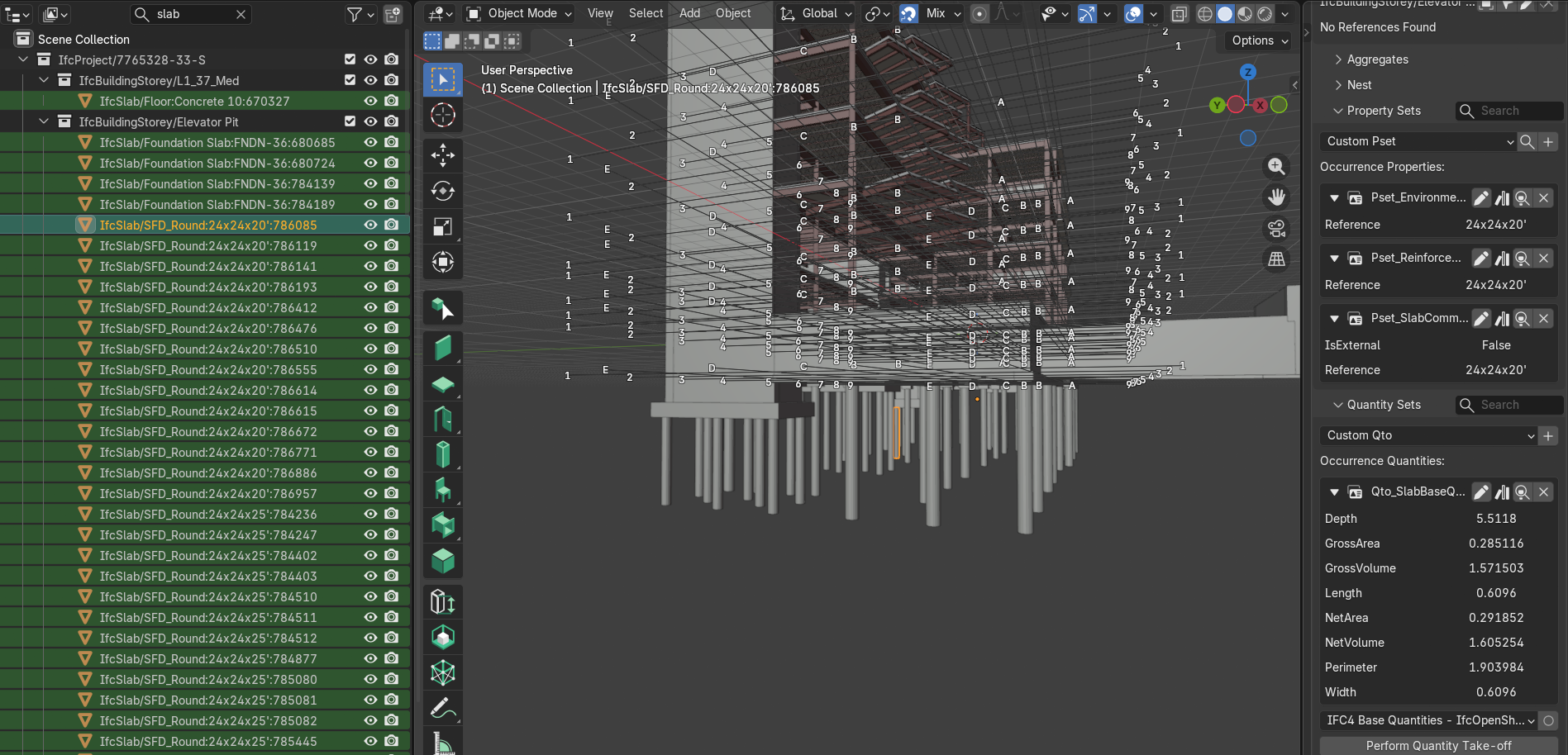
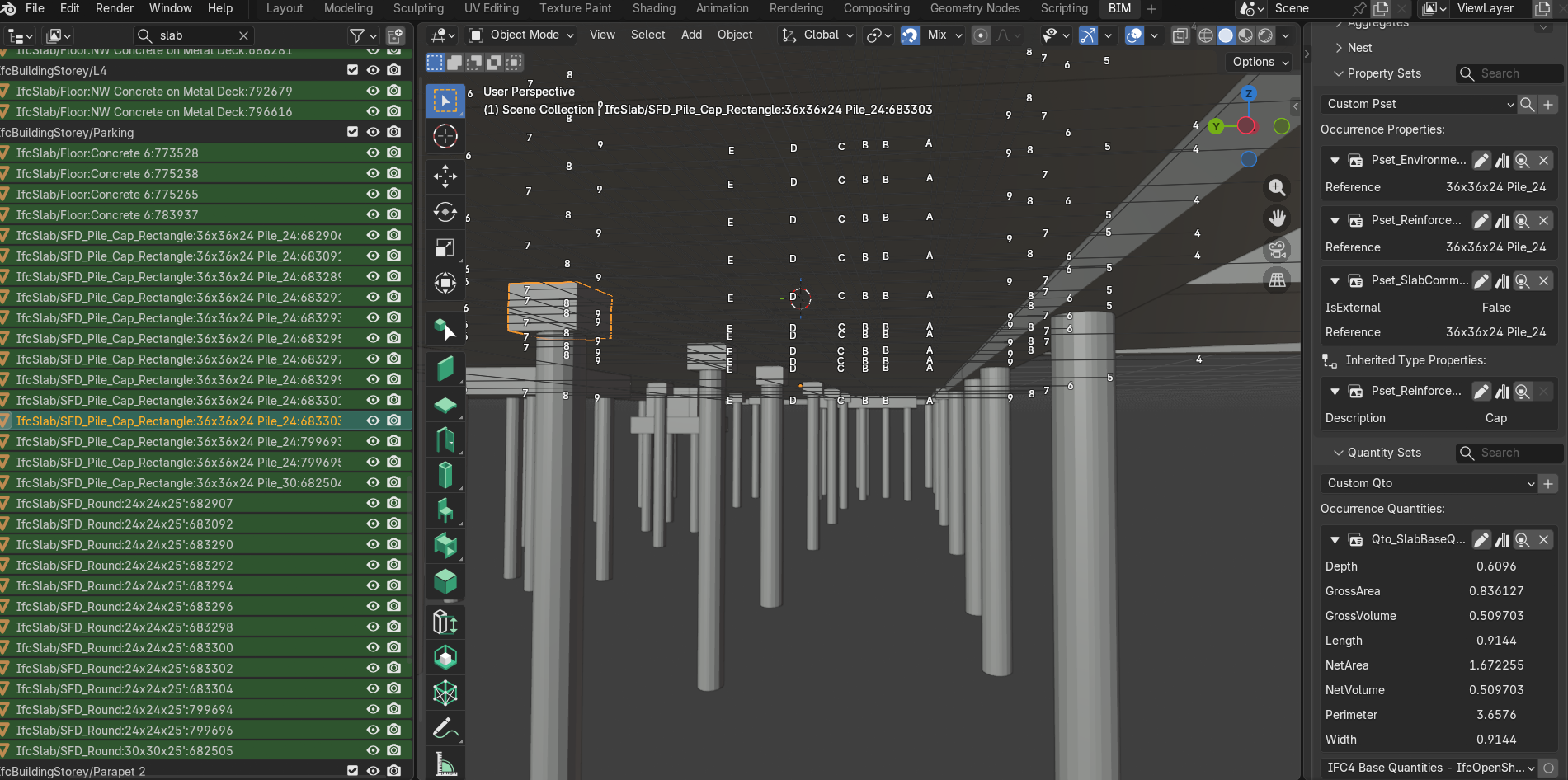
A class-only IFC extraction reads IfcFooting and returns 9 elements and 56.88 m³. This is incomplete. The model contains an additional foundation system encoded as IfcSlab with PredefinedType BASESLAB: 65 drilled caissons (30" and 24" diameter), 13 pile caps, 4 mat foundations, 9 strip footings.
On a real project, 304.74 m³ is not a rounding error — that is a full foundation system absent from procurement quantities. The correct signal is not class. It is PredefinedType.
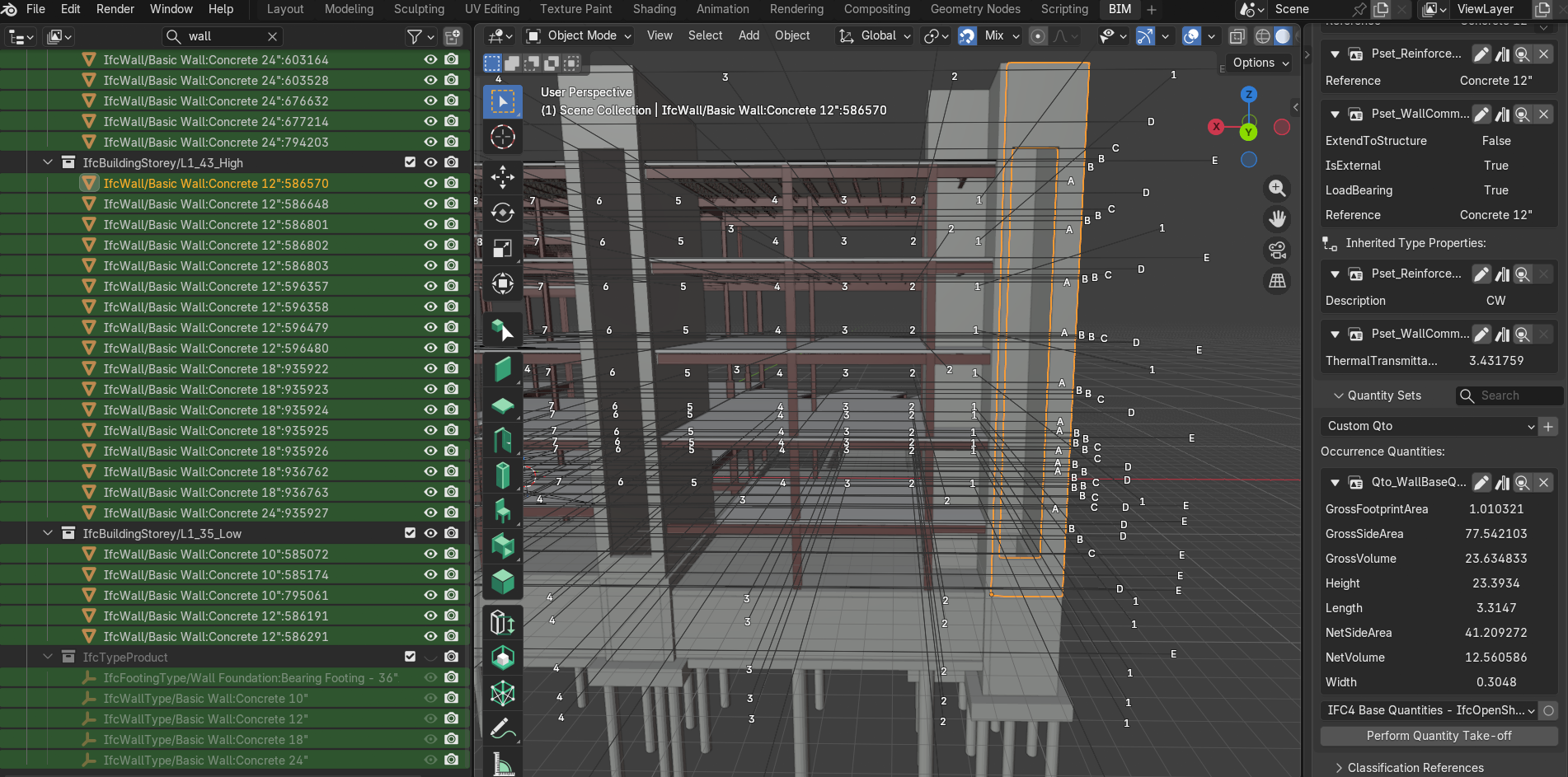
Three shear walls contain major openings: Wall A — 51% of gross volume removed; Wall B — 47%; Wall C — 26%. GrossVolume is the solid wall before openings. NetVolume is after subtractions. These are materially different quantities.
Shear wall system — 58 walls, 1,164.94 m³ total. Using GrossVolume systematically overstates concrete across every perforated wall in the lateral core. NetVolume verified against Bonsai for all 58 elements. The distinction is not computational. It is commercial.
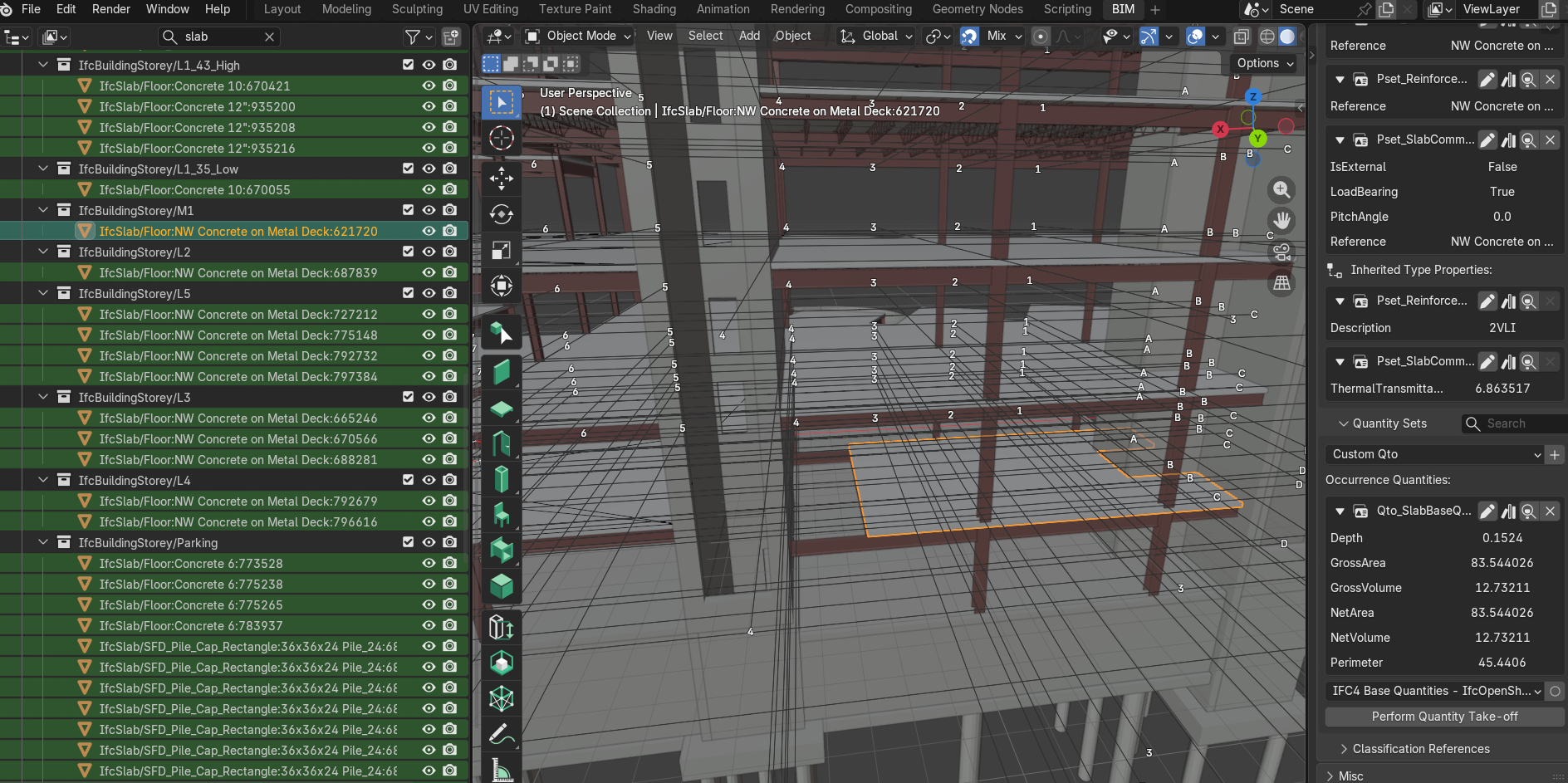
12 floor slabs are NW Concrete on Metal Deck — Vulcraft 2VLI system. Total IFC volume 601.05 m³. The 2" steel ribs displace concrete but IFC geometry models these slabs as flat plates — rib geometry was never modeled. At €120 per m³, rib displacement overstates concrete by an estimated €10,800 to €14,400 on this element group alone.
The engine isolates the concrete layer and excludes steel decking from quantities. But it cannot correct what the geometry does not model. Documented in the validation report with correction range. The QS applies the rib displacement factor from structural drawings.
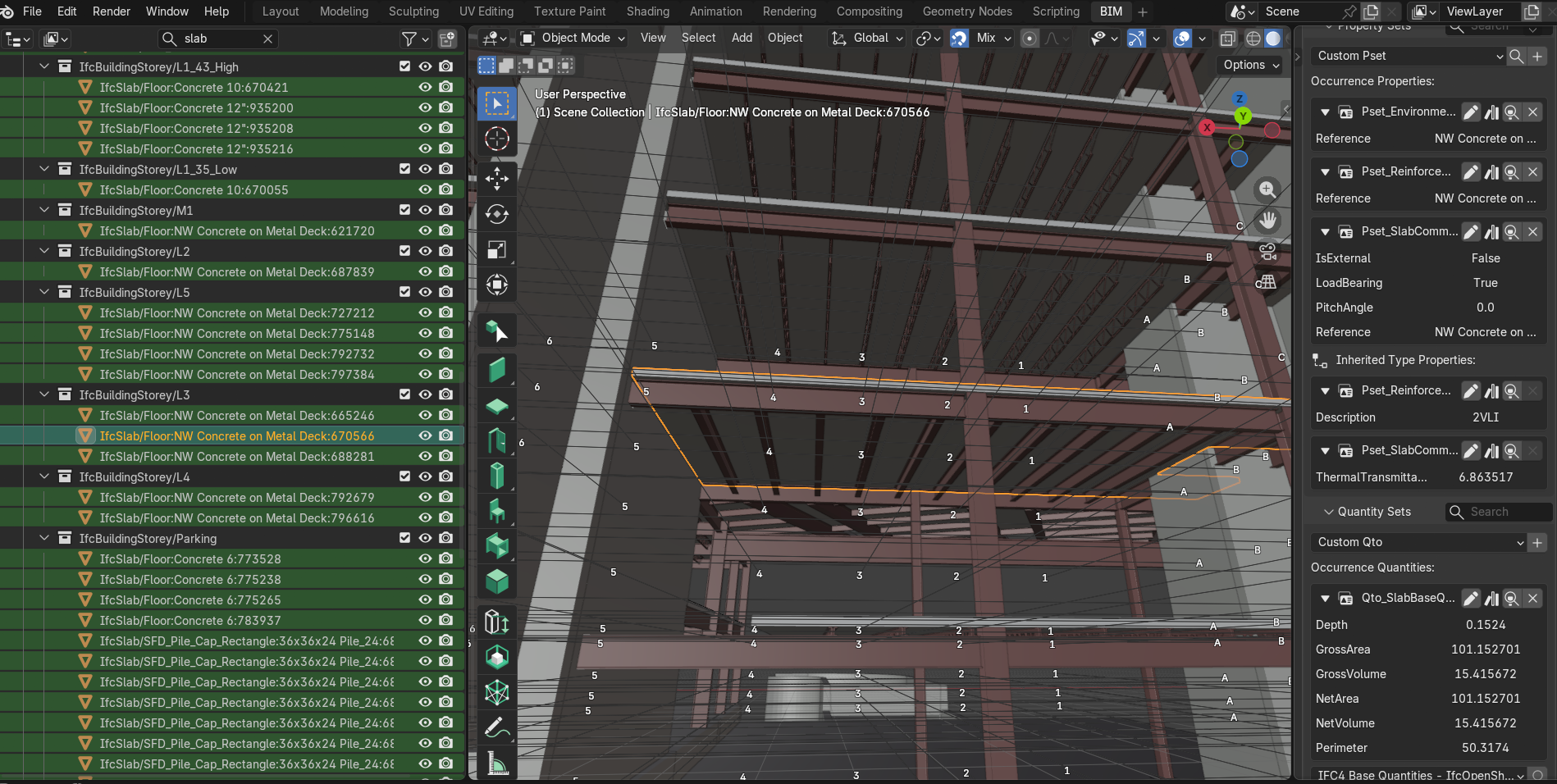
50 IfcBuildingElementProxy elements at the elevator pit transition zone — steel embed plates and headed anchor studs (SCN_Embed and SCN_HAS systems) connecting the concrete core to the steel frame above. Physical components but not structural concrete for BOQ purposes. Correctly excluded. Zero volume contribution. The concrete-to-steel interface is one of the most failure-prone classification zones in mixed-material buildings. No misclassification observed.
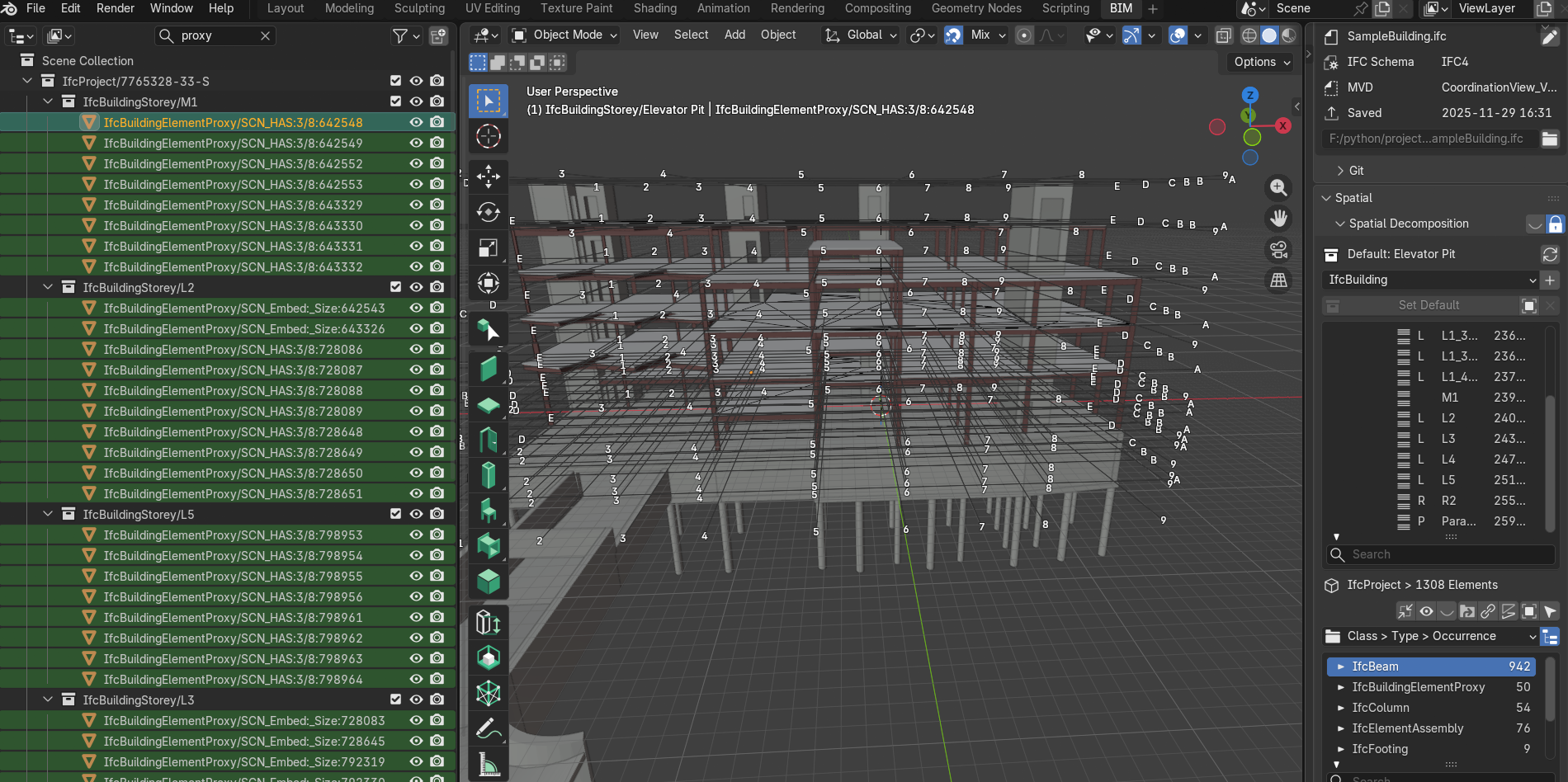
218 concrete elements validated against IFC BaseQuantities. Zero geometric fallback required. Classification accuracy 99.6% across all 1,221 elements processed.
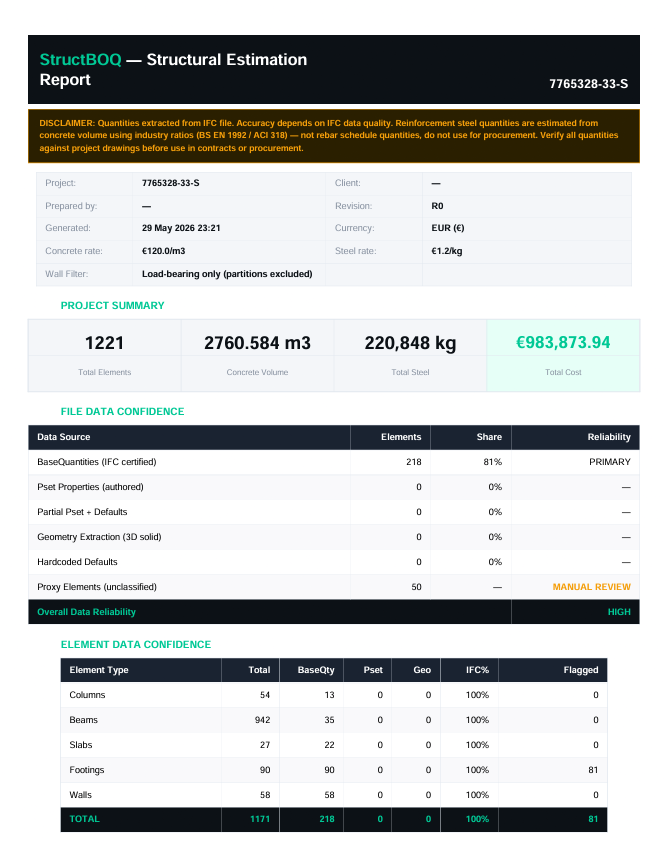
These are the actual StructBOQ outputs generated from this IFC file. No data has been modified. Cost figures use default rates (€120/m³ concrete, €1.2/kg steel) and are indicative only — not market rates. Download and open to inspect the full element-level breakdown, confidence scoring, and validation findings.
Generated by StructBOQ v3.3 · shabirbim.com · Outputs are unmodified engine results
Steel reinforcement not explicitly modeled. Total reinforcement 221,040 kg — ratio estimated from BS EN 1992 and ACI 318. Uncertainty range ±30 to 50%. Not suitable for procurement or fabrication. Composite slab rib displacement of 90–120 m³ not resolved in IFC geometry — requires QS correction from structural drawings.
This is not an unusual building. It is a standard commercial typology. At this scale — entire foundation systems are missed under class-only extraction. Shear wall volumes include physically removed geometry. Composite slabs embed unmodeled displacement errors. Steel hardware exists inside structural zones and must be excluded.
IFC classes alone are insufficient for system-level interpretation. At production scale, IFC validation is not about detecting errors — it is about correctly interpreting every quantity before it becomes a cost decision.