Small files are not safe files.
This is a buildingSMART public test model representing a reinforced concrete lift shaft wall exported from Allplan 2014. Four walls, one footing, thirteen rebar groups. Eighteen structural elements. On paper — a straightforward extraction scenario.
Geometry was present. The model was complete. The extraction logic was incomplete.
- 18 structural elements
- 4 reinforced concrete walls
- 1 concrete footing
- 13 rebar groups — 189 individual bars
- 520 IfcAnnotation entities
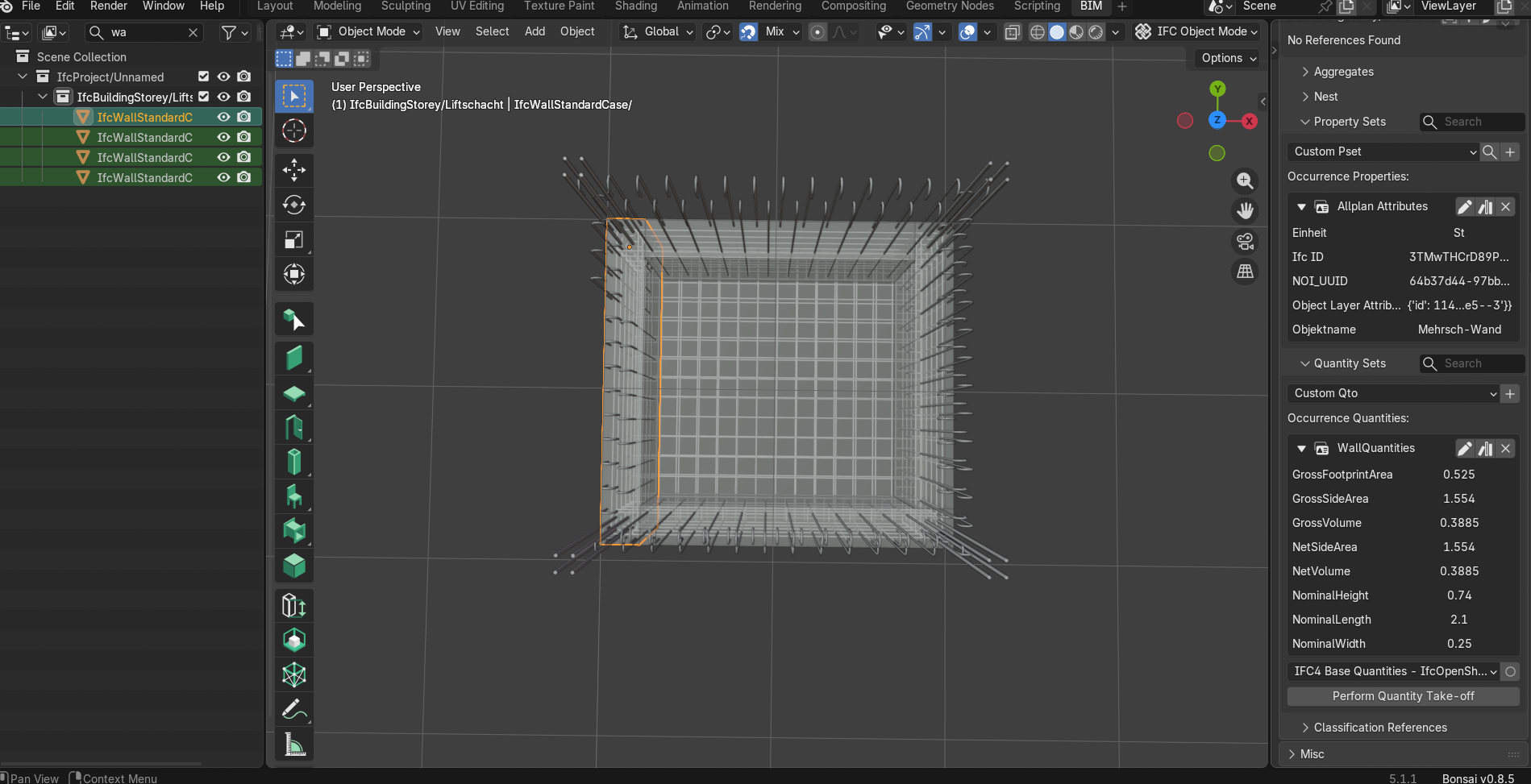
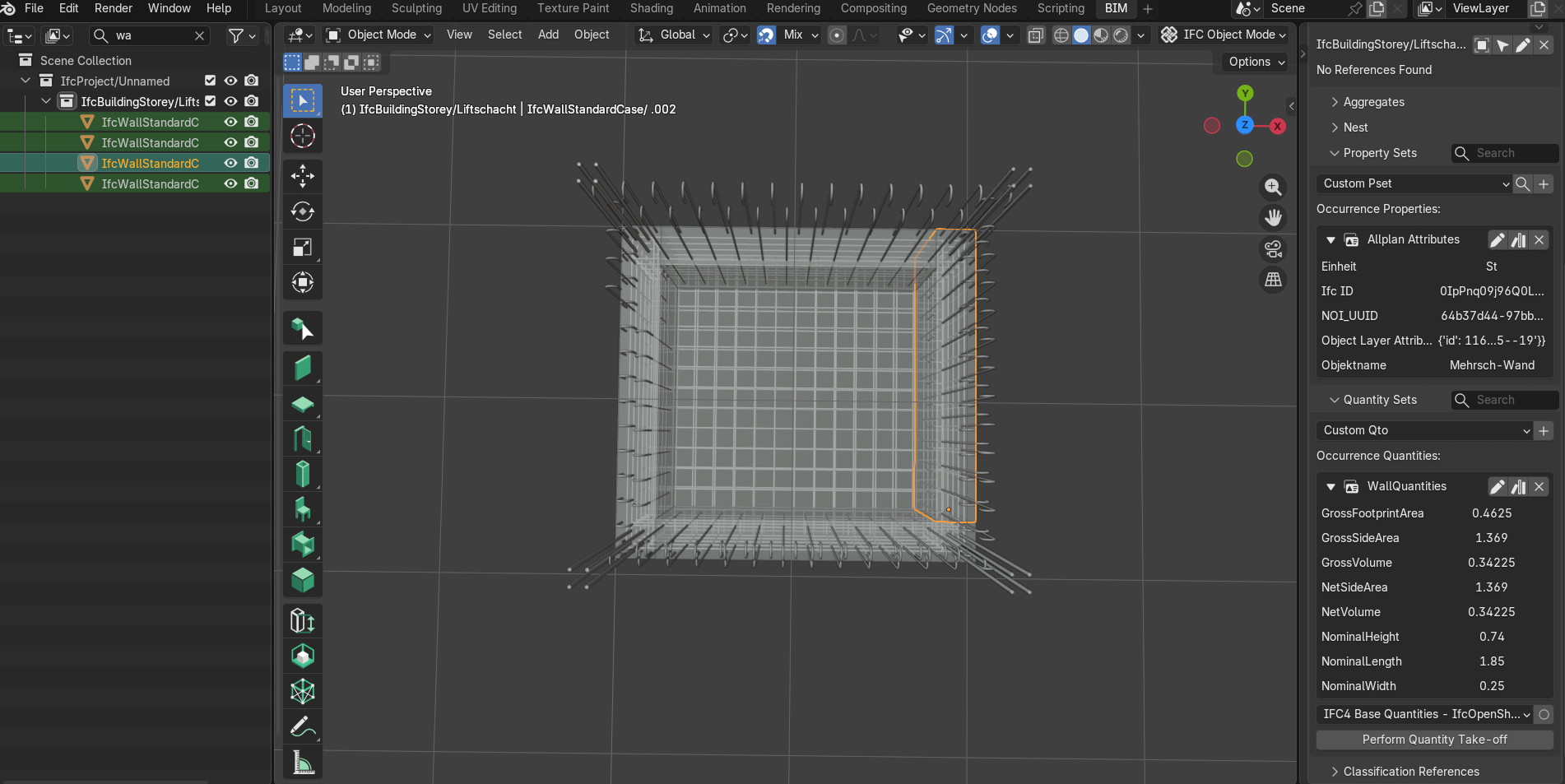
Allplan does not rely on standard IFC quantity set names. It exports proprietary sets: WallQuantities, FootingQuantities. A parser restricted to standard set names defaults to geometric estimation — even when valid quantities are fully present in the file.
This is not missing data. It is non-standard placement of valid data. Once proprietary quantity sets were mapped, all concrete volumes were extracted directly. No geometric fallback required.
The IFC schema defines CrossSectionArea in m². Allplan exports this value in cm². No metadata flag indicates the unit deviation. The value is syntactically valid but semantically incorrect under IFC assumptions.
The pipeline applies explicit cm² → m² conversion for Allplan-derived reinforcement data prior to all calculations.
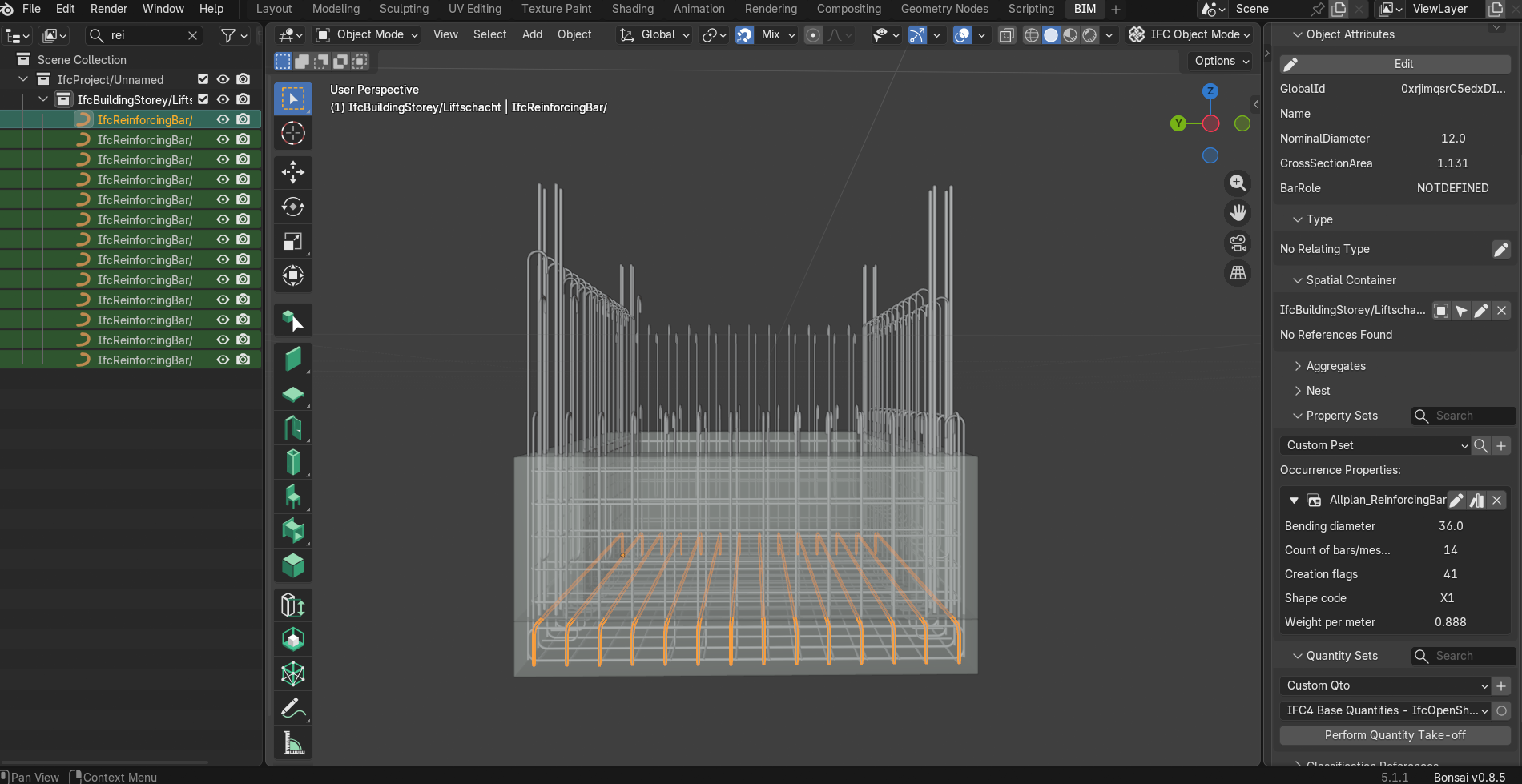
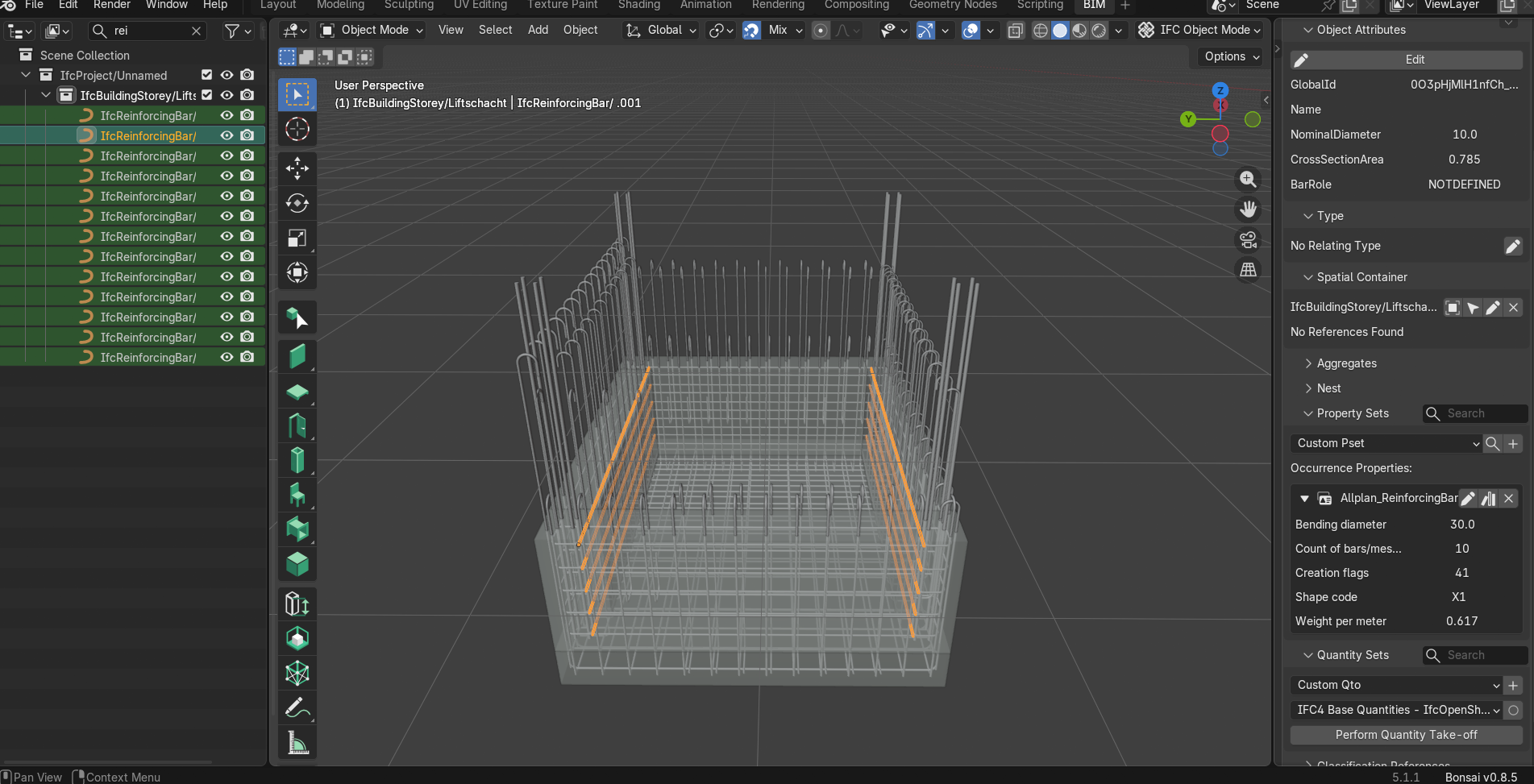
The initial extraction assumed bar length was unavailable and applied ratio-based estimation. This assumption was incorrect. Each IfcReinforcingBar contains a geometric representation defined by an IfcPolyline directrix describing the full bar centerline, including bends and hooks. Bar length is directly derivable from geometry.
The data was present. It was not initially traversed.
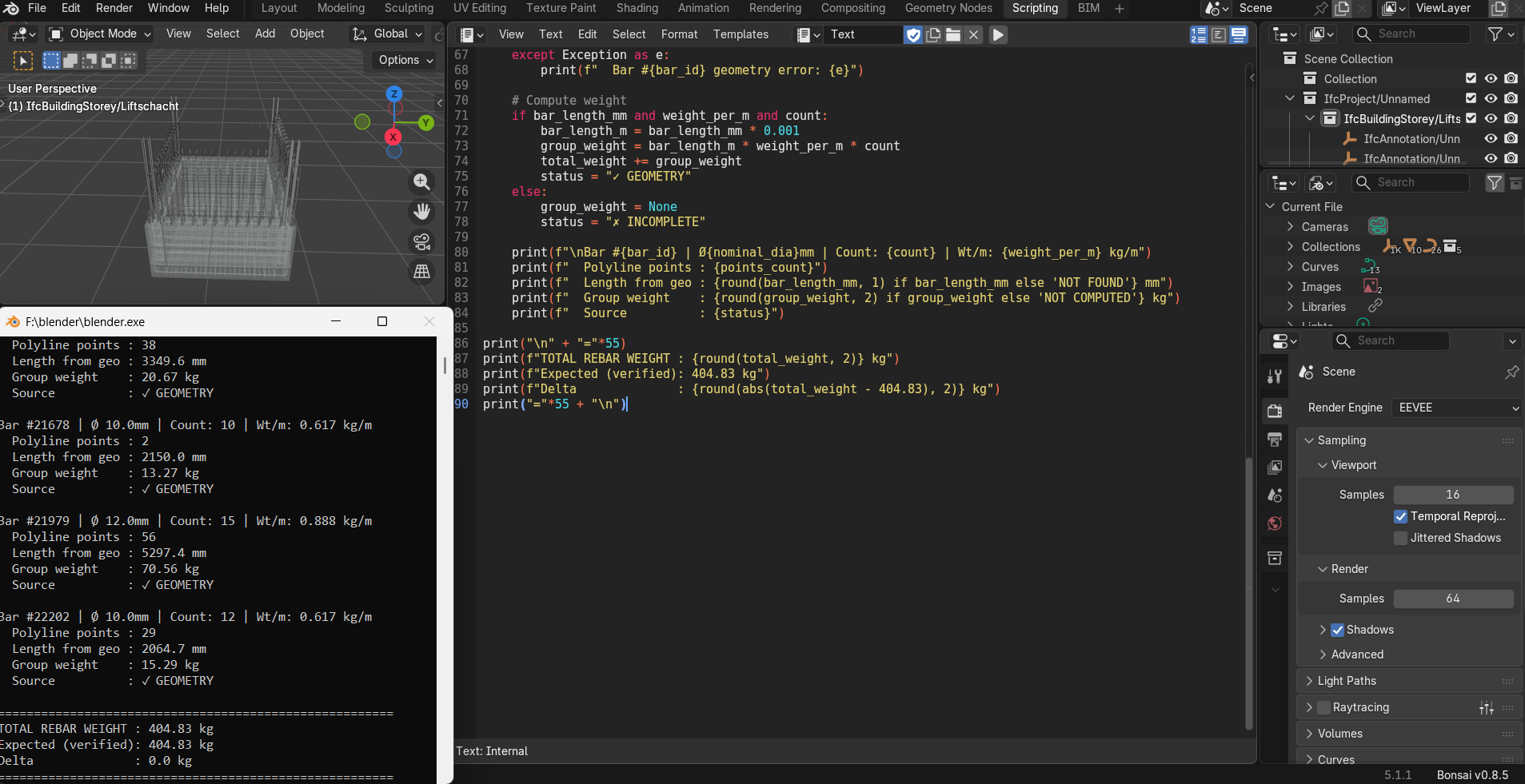
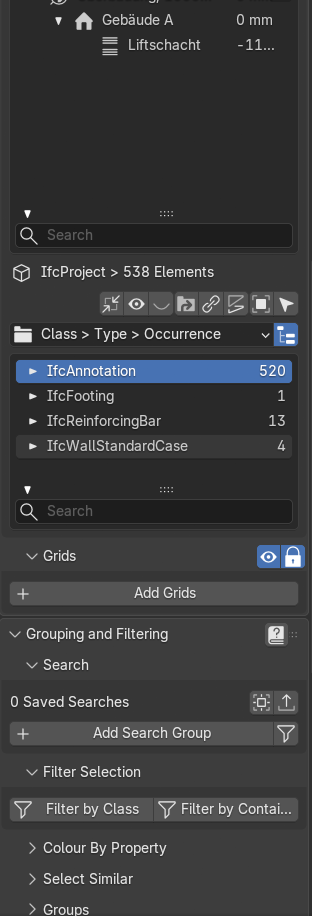
The model contains 520 IfcAnnotation entities — reinforcement drawings, dimension lines, labels, symbolic geometry — alongside 18 structural elements. Without explicit filtering, annotation entities distort element counts, classification logic, and downstream aggregation. At scale, this pattern introduces thousands of non-structural objects into structural datasets. All annotations must be excluded prior to extraction.
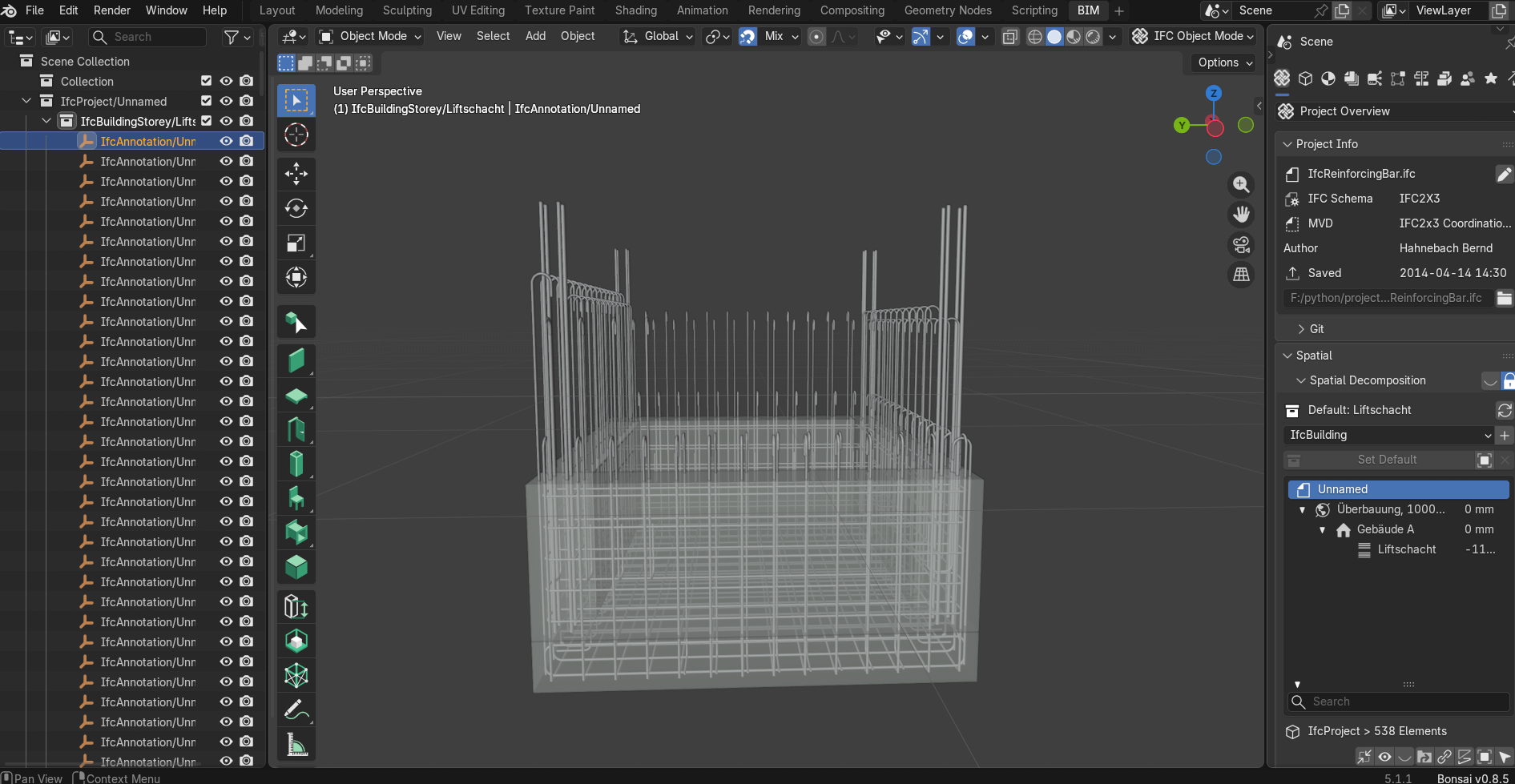
Derived from geometric extraction and Allplan quantity sets. Confirmed against Bonsai. Steel grade B500B — confirmed via IfcMaterial association through HasAssociations relationship.
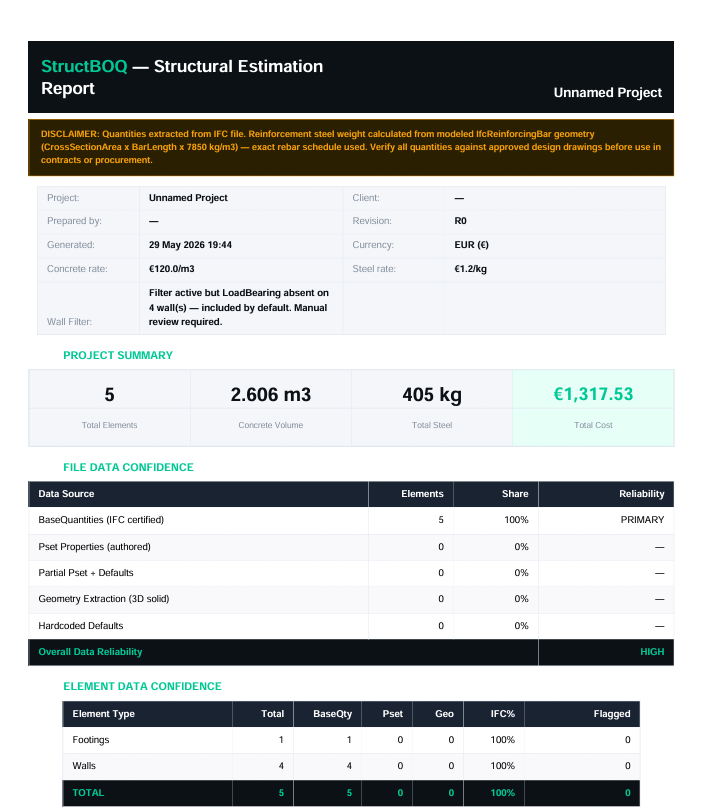
These are the actual StructBOQ outputs generated from this IFC file. No data has been modified. Cost figures use default rates (€120/m³ concrete, €1.2/kg steel) and are indicative only — not market rates. Download and open to inspect the full element-level breakdown, confidence scoring, and validation findings.
Generated by StructBOQ v3.3 · shabirbim.com · Outputs are unmodified engine results
Concrete grade is not present in the IFC export — not in property sets, material definitions, naming conventions, or classification metadata. This is an upstream authoring omission in Allplan 2014 and cannot be reconstructed downstream. A default rate is applied and reported explicitly.
The initial failure was not computational. It was structural. Key information existed across multiple non-standard locations: proprietary quantity sets, geometric representations, material association paths, naming layers. None aligned with standard IFC extraction assumptions.
IFC information is rarely absent. It is fragmented across schema layers, encoded inconsistently across authoring tools, and often recoverable only through geometry rather than property sets. Most extraction pipelines fail at discovery, not calculation. The correction was not a model fix — it was a shift in assumption hierarchy.